Drowning prevention begins with understanding where the risks are—and who is being impacted.
Updated data from the California Department of Public Health provides a closer look at fatal and nonfatal drowning among San Diego residents from 2016 through 2024.
The data tells an important story: drowning affects people of all ages, occurs in many different environments, and does not always result in death.
What Does the Data Show?
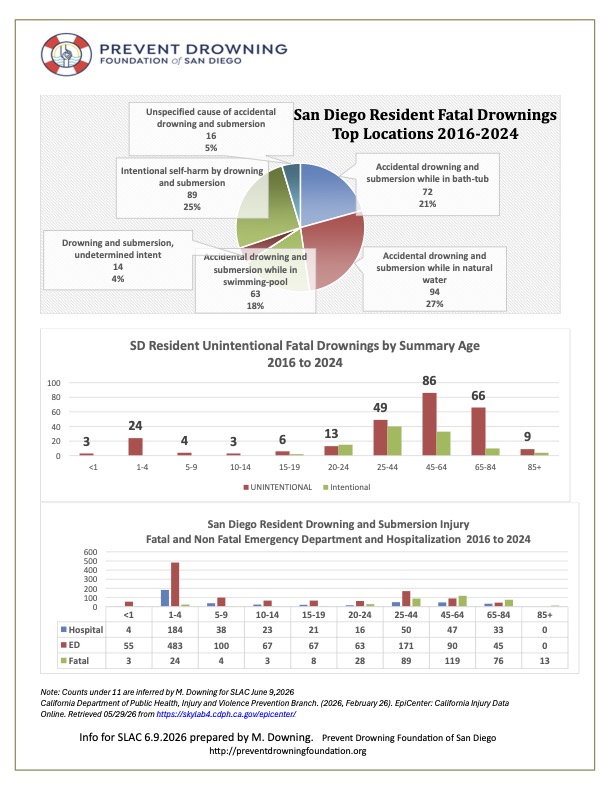
The graphic provides three different views of drowning and submersion incidents among San Diego residents.
Where fatal drownings occur
The top section looks at fatal drownings by cause or location. Natural water represents the largest accidental drowning category shown, with 94 deaths, followed by bathtubs with 72 and swimming pools with 63. The data also includes intentional self-harm by drowning, drownings of undetermined intent, and accidental drownings where the specific cause was unspecified.
Drowning affects every age
The middle section focuses on unintentional fatal drownings by age. While young children remain an important focus of drowning prevention—with 24 unintentional fatal drownings among children ages 1–4—the numbers show clearly that drowning is not only a childhood issue.
Adults ages 45–64 had the highest number of unintentional fatal drownings shown in the data, with 86 deaths, followed by adults ages 65–84 with 66 and ages 25–44 with 49.
This reinforces the importance of water safety education at every stage of life.
Fatal drownings are only part of the story
The bottom section expands the picture by showing emergency department visits, hospitalizations and fatalities.
The impact among young children is particularly striking. Among children ages 1–4, the data shows 483 emergency department visits and 184 hospitalizations related to drowning and submersion injuries from 2016 through 2024, in addition to 24 fatalities.
Nonfatal drowning incidents can be serious, making prevention before an incident occurs critically important.
Turning Data Into Prevention
These numbers reinforce why drowning prevention requires multiple layers of protection: active supervision, barriers to prevent unsupervised access to water, learning to swim and developing water competency, properly fitted life jackets when appropriate, and knowing CPR with rescue breaths.
For PDFSD, the data also reinforces the importance of continuing to expand access to swim lessons and water safety education throughout our community.
Drowning is preventable. Together, we can help make San Diego safer in and around the water.
Source: California Department of Public Health, Injury and Violence Prevention Branch, EpiCenter: California Injury Data Online. Data retrieved May 29, 2026. San Diego resident data, 2016–2024.